Overview
A concise introduction to Open PenQuin: why quantum systems need geometric pentesting and how linear structures make it possible
The Problem
Right now, program loops are geometrically unmeasurable domains for cybersecurity engineers. Finding and exploiting loops is never assigned a probability in penetration tests. What’s possible today are pattern-based scans that employ some type of distribution. The low-level program loops specified by both macro and microkernel conditions have an empirical chance of being found and exploited through repeated pentesting — but the conditions are only a generic distribution rather than a detailed structure. Ultimately, the distribution or scan being used depends on the precise underlying Worst Case Execution Time (WCET) and Worst Case Execution Path (WCEP) of program loops.
The precise microstate of a program loop running in quantum hardware, firmware, or software simply doesn’t get any immediate mathematical purchase from a distribution-based approach. A pentest for quantum systems, expected to run in parallel or at least close to parallel, requires a structure to “fill in” a generic description to yield a specific description of a loop’s WCET and WCEP.
Our Solution
Open PenQuin introduces linear structures as the foundational mathematical framework for analyzing quantum program loops. The central idea is deceptively simple: the topology of a loop can be constructed with lines. Lines are the most fundamental geometrical structure that can organize assembly code into a space. By decomposing loops into their constituent line structures, Open PenQuin can see the most basic geometry of the loops it wishes to analyze.
Open PenQuin will use an a priori algorithm, such that its reinforcement learning agent can use empirical experiences from its policy — because it can measure the microdynamics of a loop and measure fundamental signals like voltage, capacitance, and more — to inform its structure for analyzing loops. This is a fundamental pivot away from distribution-based, chance-based approaches toward geometry-based analysis.
Linear Structures at a Glance
Lines in Open PenQuin’s framework are categorized by their endpoints, which are called colored bits. There are three fundamental line types: open lines (no colored bits), closed lines (two colored bits), and half-open lines (one colored bit). Sequences of directed lines form directed chains, which Open PenQuin uses to trace and analyze Worst Case Execution Paths.

How It Works
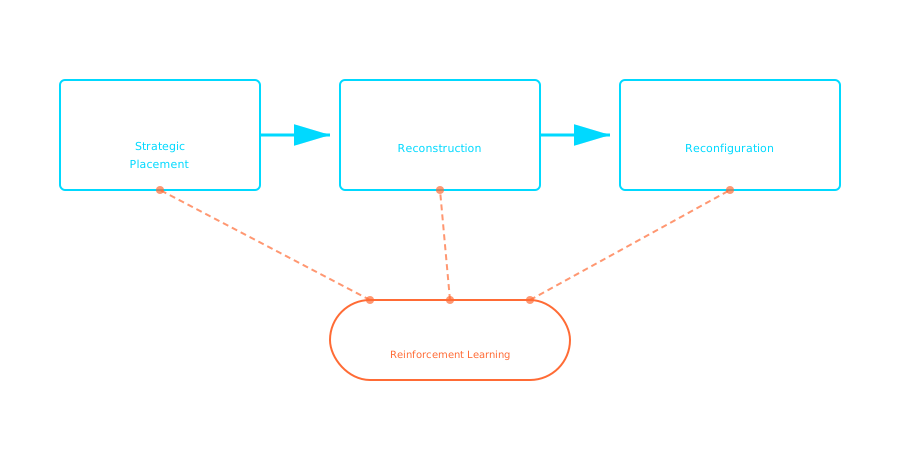
Open PenQuin is built as a modular system operating on quantum programs through QIR (Quantum Intermediate Representation), the bridge between high-level quantum programming languages and target quantum hardware. The architecture consists of three primary module groups — strategic placement (sleeper gadgets), quick reconstruction (proglets), and reconfiguration (lateral movement, simulation, p-bits) — all driven by a reinforcement learning engine training algorithms to generate and evaluate its security analyses.
Next Steps
- Linear Structures — A detailed exploration of the mathematical framework: line types, colored bits, directed chains, extensions, boundaries, and higher structures.
- Code — Browse the source code and implementation details on GitHub.